
Vitamin E mega-dose experiment results are in!
Why I Used 1500 IU Without an AI, and What Happened to Estrogen, GH, and Prolactin

Why vitamin E matters so much for men
Vitamin E was not discovered as a “heart health antioxidant.”
It was identified as a fertility vitamin.
Early deficiency experiments showed that without vitamin E, animals developed:
infertility
testicular degeneration
endocrine organ shrinkage
That already tells you something important: vitamin E doesn’t primarily act on circulation; it acts on hormonal tissue.
Vitamin E accumulates preferentially in:
testes
adrenals
pituitary
thyroid
hypothalamus
These are not general-health organs.
These are command centers of male physiology.
Vitamin E is a fat-soluble, lipid-phase antioxidant, meaning it embeds directly into cell membranes. That matters because steroid hormones are not produced in the bloodstream - they’re produced inside membranes that are extremely vulnerable to oxidative damage.
When oxidative stress rises:
LH signaling becomes inefficient
cholesterol transport into Leydig cells drops
steroidogenic enzymes misfire
estrogen signaling starts to dominate
Vitamin E’s primary role is not to “increase testosterone,” but to protect the machinery that produces and regulates it.
That’s why vitamin E deficiency leads to:
impaired steroidogenesis
increased prolactin and estrogen dominance
poor stress tolerance
reduced training capacity
And it’s why vitamin E was historically associated with virility, resilience, and recovery long before we could measure hormones directly.
Why vitamin E is uniquely beneficial for male hormones
I didn’t megadose vitamin E randomly.
There are decades of human and mechanistic evidence showing that vitamin E directly supports male endocrine function - not indirectly through “general health,” but at the level of steroidogenesis, estrogen control, and prolactin regulation.
That’s why it was worth testing at a dose high enough to actually matter.
Vitamin E and testosterone
Vitamin E was originally identified as a fertility factor for a reason.
It is required for:
normal testicular structure
Leydig cell integrity
steroidogenic enzyme function
Vitamin E deficiency leads to (R, R):
reduced testicular size
impaired testosterone synthesis
decreased LH receptor sensitivity
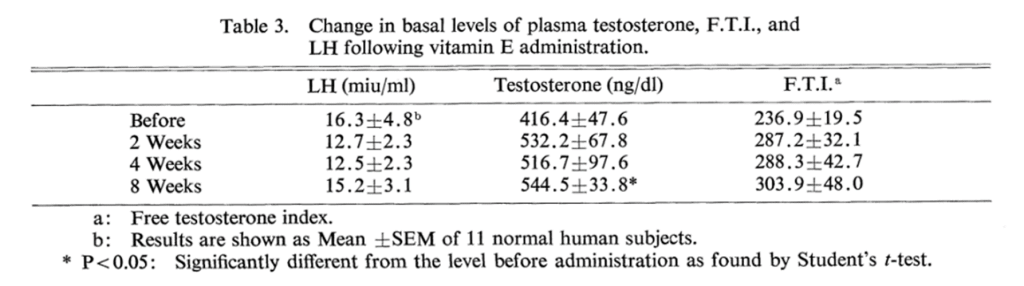
In humans, vitamin E supplementation has been shown to:
increase testosterone
reduce LH, indicating improved Leydig cell sensitivity, not overstimulation
In one study, ~700 IU/day of vitamin E increased testosterone by ~128 ng/dL while lowering LH - a clear signal that testosterone production became more efficient, not forced.
This fits vitamin E’s known effects on:
cAMP signaling
StAR-mediated cholesterol transport
P450scc activity
All of which are redox-sensitive steps in steroidogenesis.
That alone makes vitamin E a rational compound to test under high androgen load.
Vitamin E, estrogen, and aromatase
Vitamin E influences estrogen through two distinct mechanisms (R):
Aromatase inhibition
Estrogen receptor antagonism (2500mg vitamin E is needed to antagonize estrogen by 65% (R))
It does not behave like a pharmaceutical AI, but it meaningfully reduces estrogen signaling dominance. So even if it doesn’t lower estrogen, it still blocks/diminishes the effects on a cellular level.
High-dose vitamin E has been shown to:
block estrogen receptor activation
reduce aromatase activity in peripheral tissues
Importantly:
it does this without crashing estrogen
and without impairing androgen signaling
That makes it especially relevant for men:
with high aromatization pressure
under stress
or running supraphysiologic testosterone
Which is exactly the context in which I tested it.
Vitamin E and prolactin
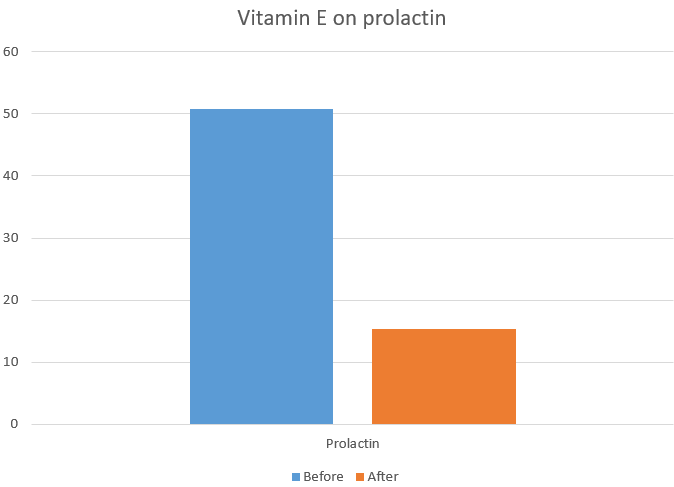
Vitamin E has a well-documented anti-prolactin effect, especially in inflammatory or stressed states.
In clinical studies:
~300 mg/day of vitamin E significantly reduced prolactin in men with elevated baseline levels (R)
had minimal effect when prolactin was already low
That’s an important pattern.
Vitamin E doesn’t suppress prolactin blindly, it normalizes stress-driven prolactin elevation.
Given prolactin’s antagonistic effects on:
testosterone
dopamine
libido
motivation
This alone makes vitamin E highly relevant for male hormonal resilience.
Why dose matters (and why I didn’t underdose it)
Vitamin E is a lipid-phase antioxidant.
That means:
it embeds into membranes
accumulates in endocrine tissue
and is consumed as it neutralizes oxidative stress
Low doses often don’t register physiologically, especially under:
inflammation
high training load
high androgen levels
If vitamin E is being used to:
protect steroidogenic membranes
buffer aromatization
stabilize endocrine signaling
Then it needs to be used at a dose high enough to change the redox environment.
That’s why I didn’t test a token dose.
Why this justified the experiment
Taken together, vitamin E has evidence for:
increasing testosterone efficiency
reducing estrogen dominance
lowering prolactin
protecting endocrine tissue under stress
So the real question wasn’t “does vitamin E do anything?”
The question was:
Does vitamin E still work when aromatization pressure is extreme and without acting like a drug?
That’s what the rest of the article answers.
The modern vitamin E problem
Most vitamin E supplements on the market are ineffective for male hormonal physiology.
They fall into three categories, all flawed in different ways.
Alpha-tocopherol–only supplements
Alpha-tocopherol is the primary hormonal modulator of vitamin E.
The body preferentially retains it in endocrine tissue.
But isolating it creates a problem:
removes synergistic tocopherols
chronically suppresses gamma-tocopherol
creates an imbalanced signal profile
These products often feel “neutral” or disappointing because they’re incomplete.
Wheat germ oil (food form)
Wheat germ oil is the natural source, but not a practical intervention.
Problems:
vitamin E concentration is too low
requires large volumes
brings a heavy PUFA load
inefficient for targeted endocrine effects
It’s nutritionally interesting, but not a therapeutic tool.
High gamma-tocopherol products
Gamma-tocopherol is excellent for:
oxidative stress
inflammation
toxin neutralization
But it does very little for:
steroidogenesis
androgen signaling
pituitary or testicular function
Key distinction:
Gamma-tocopherol protects against damage.
Alpha-tocopherol modulates hormones.
Most modern products emphasize the former and ignore the latter, which is why vitamin E’s reputation has quietly declined in male health.
Why I revisited vitamin E (and why Gironda mattered)
Vince Gironda didn’t recommend vitamin E casually.
He specifically pointed to vitamin E extracted from wheat germ, not generic oils or isolates.
That matters because this form:
is highly alpha-tocopherol dominant
contains a broader tocopherol spectrum
includes policosanol, which supports lipid handling and hormonal efficiency and has unique performance enhancing benefits
Today, this concentrated extract is one of the only formats that resembles what Gironda was actually using, without the PUFA overload of whole wheat germ oil.
Instead of theorizing, I wanted to see how this form behaved in a real physiological context, not a pristine lab fantasy.
The experiment (with full context)
At the time of this experiment, I was running testosterone at 1.2 g per week as part of a muscle-building phase.
Important details:
No aromatase inhibitor was used
Injection schedule:
600 mg injected on Thursday
Bloodwork taken the following Wednesday
That means labs were drawn nearly one full week post-injection
Even at that point, total testosterone was still >120 nmol/L (assay capped)
This matters, because at these androgen levels:
aromatization pressure is extremely high
estrogen control does not happen accidentally
weak interventions simply don’t show up
For comparison, my previous experiment used Damiana, which is a strong and reliable aromatase inhibitor, even under supraphysiologic testosterone exposure.
So vitamin E was not being tested in a low-stress, low-hormone environment.
It was tested where only real modulators survive.