Chicken vs. Beef: Which One Actually Lowers Your Iron?

Why “Low Iron” Foods Won’t Lower Your Ferritin (And What Actually Will)
Most people would recommend switching to white meat if you want to lower ferritin.
If your ferritin or transferrin saturation comes back elevated, the advice you’ll hear almost everywhere is the same: cut red meat, cut organ meat, switch to chicken and fish. It feels intuitive. Less iron going in should mean less iron in the body.
It’s also wrong, and I’ve now proven it wrong on myself twice, in opposite directions.
The premise everyone gets backwards
Chicken breast is genuinely low in iron. Nobody disputes that. But whether a food actually helps you lower your iron status has almost nothing to do with how much iron it contains in isolation.
What matters is the ratio of zinc to iron in what you’re eating, because zinc and iron compete for the same absorption transporter in the gut, DMT1. Flood the gut lumen with zinc relative to iron, and you meaningfully blunt how much iron actually gets absorbed, almost regardless of how much iron is technically sitting on the plate.
Chicken breast has a zinc-to-iron ratio of roughly 1.4:1. That’s not disastrous, but it’s mediocre, and its absolute zinc density is low to begin with. So switching to chicken specifically to bring iron down doesn’t just fail to fix the problem, it can actively work against you, because you’re simultaneously starving your zinc status without doing much for the ratio that actually controls iron absorption.
Proof, in the direction nobody expects: my oyster experiment
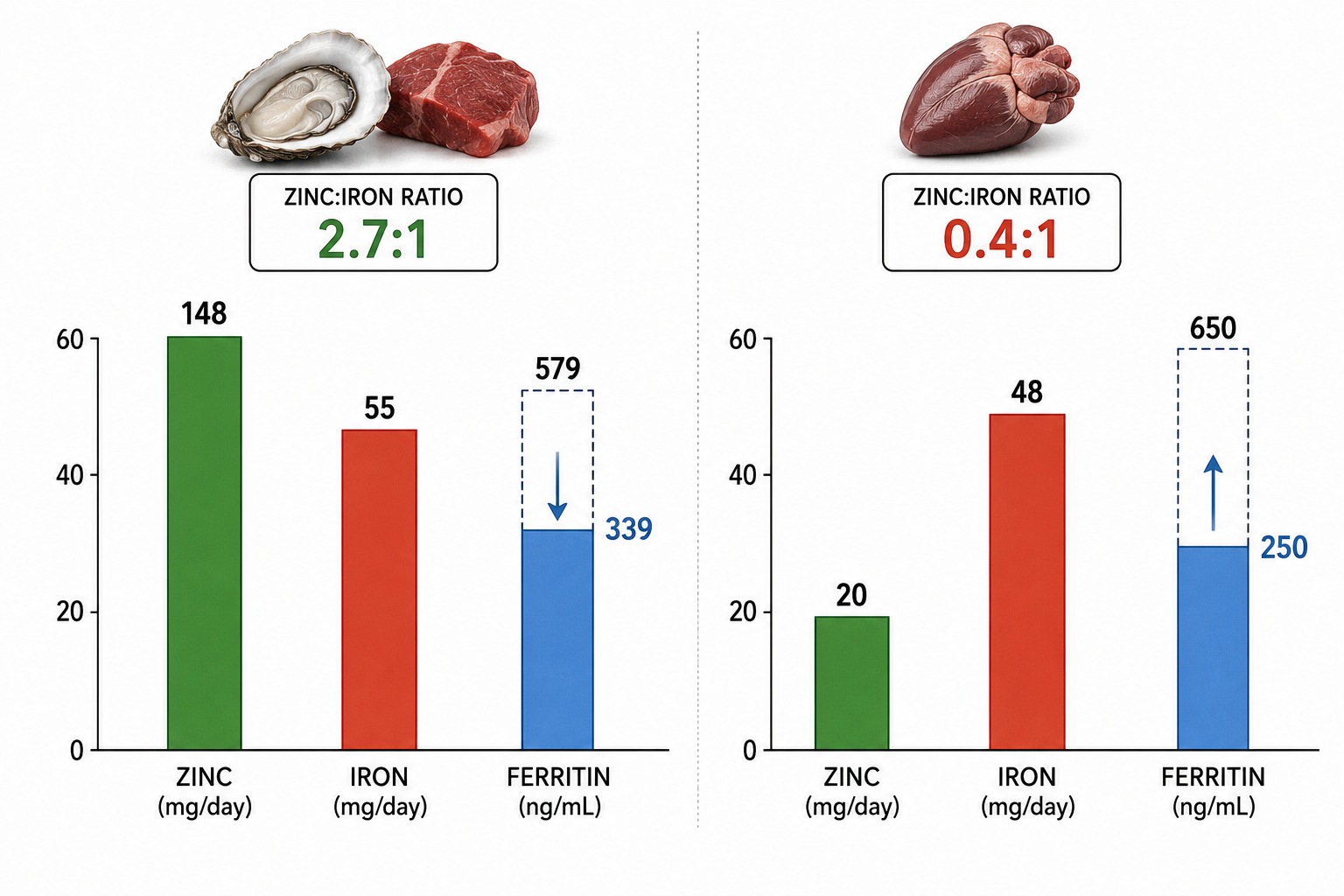
Here’s an experiment that still surprises people when I describe it. I ate roughly 15 oysters a day for 30 days on top of extra red meat. My total iron intake came out to around 55mg a day, nearly 700% of the RDA. By any “eat low-iron foods” logic, this should have made my ferritin worse.
It dropped from 579 to 339 in that single month.
The reason is the ratio, not the absolute number. My zinc-to-iron ratio during that period was roughly 2.7:1, because oysters are extraordinarily zinc-dense, about 45mg zinc per 100g against just 6mg iron. Compare that to an earlier period when I was eating almost exclusively beef heart, where my ratio sat around 0.4:1, iron-dominant, and ferritin climbed instead, despite beef heart itself not being a particularly extreme iron source.
Here’s the ratio across a range of common foods, so you can see how this actually plays out:
Shellfish & Seafood
Oysters: 7.5 : 1
Shrimp: 2.6 : 1
Squid: 2.1 : 1
Salmon: 2 : 1
Cod: 2 : 1
Mussels: 0.3 : 1
Clams: 0.08 : 1
Land Meats
Pork (loin): 2.7 : 1
Lamb: 2.1 : 1
Beef (lean ground): 1.8 : 1
Bison: 1.2 : 1
Chicken (breast): 1.4 : 1
Turkey (breast): 1.1 : 1
Eggs & Organs
Eggs: 0.7 : 1
Liver (beef): 0.6 : 1
Kidney (beef): 0.7 : 1
Heart (beef): 0.4 : 1
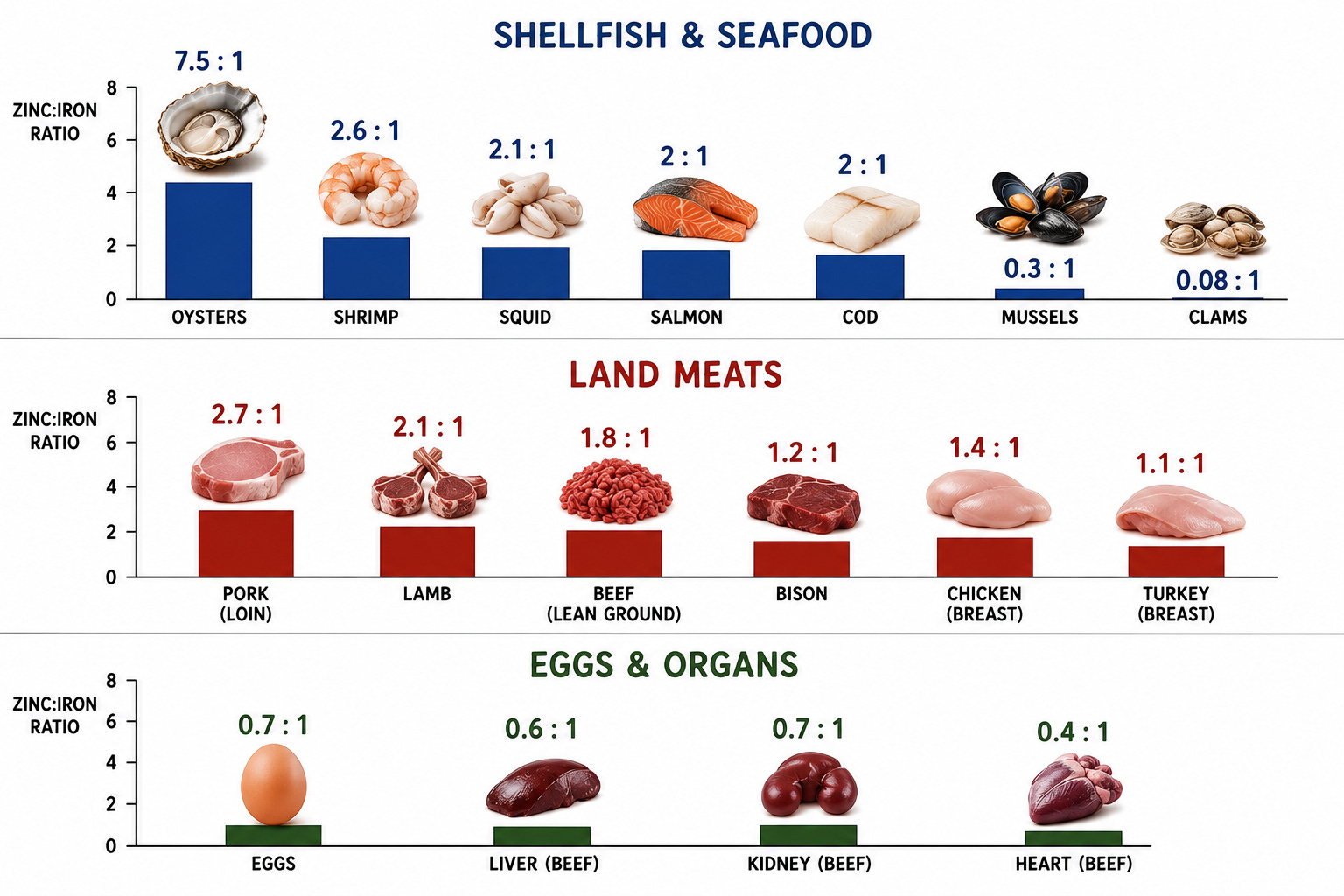
A few things jump out immediately. Chicken breast, the default “safe” choice for lowering iron, is very low in iron, but if you consume it as your main protein source, your zinc intake is also quite low.
Clams and mussels, despite being “seafood,” are some of the worst options on this entire list, iron-heavy relative to zinc despite feeling like a light, healthy choice. And oysters aren’t just good, they’re in a category of their own (most superior).
In essence, if you want to:
increase your iron/ferritin, eat mussels, clams, liver and heart.
maintain your iron, eat red meat and chicken breast (although even this might be enough to increase your ferritin).
lower your ferritin, stick to lamb, pork loin, shrimp and oysters.
One more nuance worth flagging: ratio isn’t the whole picture. Shrimp, squid, cod, and salmon all have favorable ratios on paper, but their absolute zinc content per 100g is low. That means they’re fine to include, but you don’t want them to be the foundation of an iron-lowering strategy, because there’s simply not much zinc there to do the competitive-absorption work you need. The same logic applies to chicken breast twice over: a mediocre ratio and low density, stacked together.
The real-time failure: my recent chicken and bean experiment
I’ve now watched the inverse mistake happen in real time, on myself, deliberately. During a recent diet experiment, I switched from beef to chicken specifically as a strategy to bring iron down, alongside a bean-based fiber protocol and 4mg/day of supplemental copper.
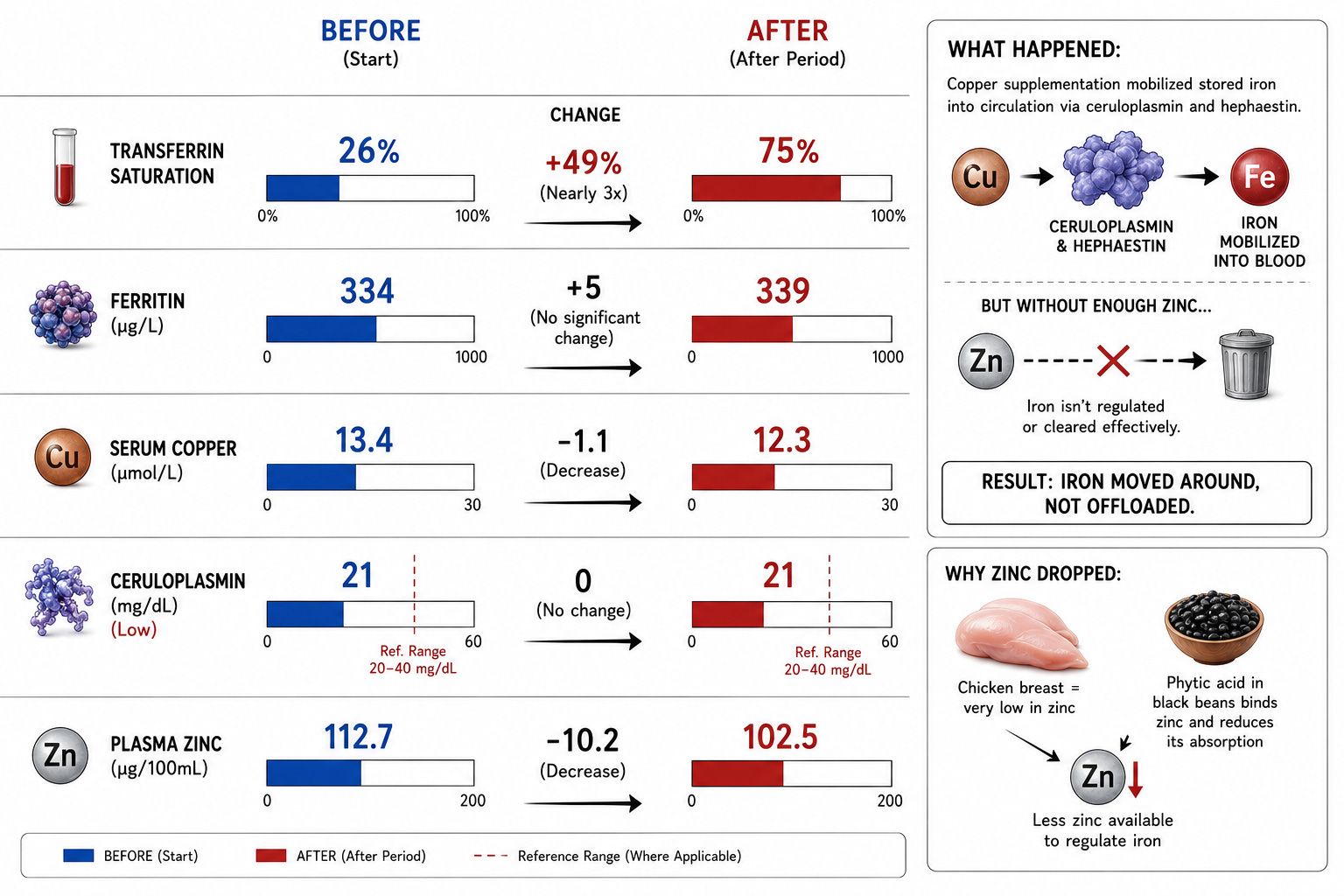
The result: my transferrin saturation went from 26% to 75% over that period, while ferritin stayed essentially flat, 334 to 339 µg/L. The copper I was supplementing was doing exactly what copper does, mobilizing stored iron into circulation via ceruloplasmin and hephaestin, but without enough zinc in the system to help regulate or clear that mobilized iron, it just moved iron around rather than helping me actually offload it.
My serum copper itself didn't rise despite direct daily supplementation, going from 13.4 to 12.3 µmol/L, and ceruloplasmin stayed completely flat at 21 mg/dL, still below the reference range on both tests. Meanwhile my plasma zinc actually dropped further, from 112.7 to 102.5 µg/100mL, likely due to chicken breast being a horrible source of zinc and the phytic acid in the black beans also binding to the little bit of zinc available.
This is, as far as I can tell, a genuinely underexplored idea: that the entire “eat low-iron foods to lower ferritin” strategy is built on a flawed premise. It’s not about how much iron you eat. It’s about what you eat it alongside. This is also, I’d argue, part of why so many people with elevated ferritin end up leaning entirely on blood donation as their only lever, because dietary strategies built around avoidance rather than ratio management mostly fail, and donation becomes the only thing that seems to move the needle, slowly, every 2-4 months, forever.
The hidden cost nobody accounts for: what chicken-heavy eating does to zinc status
Here’s where this compounds into something worse than a failed iron strategy. If you switch to chicken specifically to lower iron, you’re not just failing to fix the ratio, you’re also actively under-feeding your zinc status, and zinc has direct consequences for testosterone that have nothing to do with iron at all.
There’s a controlled trial, Prasad et al. (Nutrition, 1996), that’s about as clean as this kind of human data gets. Healthy young men had their zinc intake experimentally restricted for 20 weeks. Mean serum testosterone dropped from roughly 39.9 nmol/L to 10.6 nmol/L, a 73% decrease. In related work, older men who were marginally zinc-deficient were supplemented with 30mg zinc gluconate daily for six months, and their testosterone rose from roughly 8.3 to 16.0 nmol/L, nearly doubling.
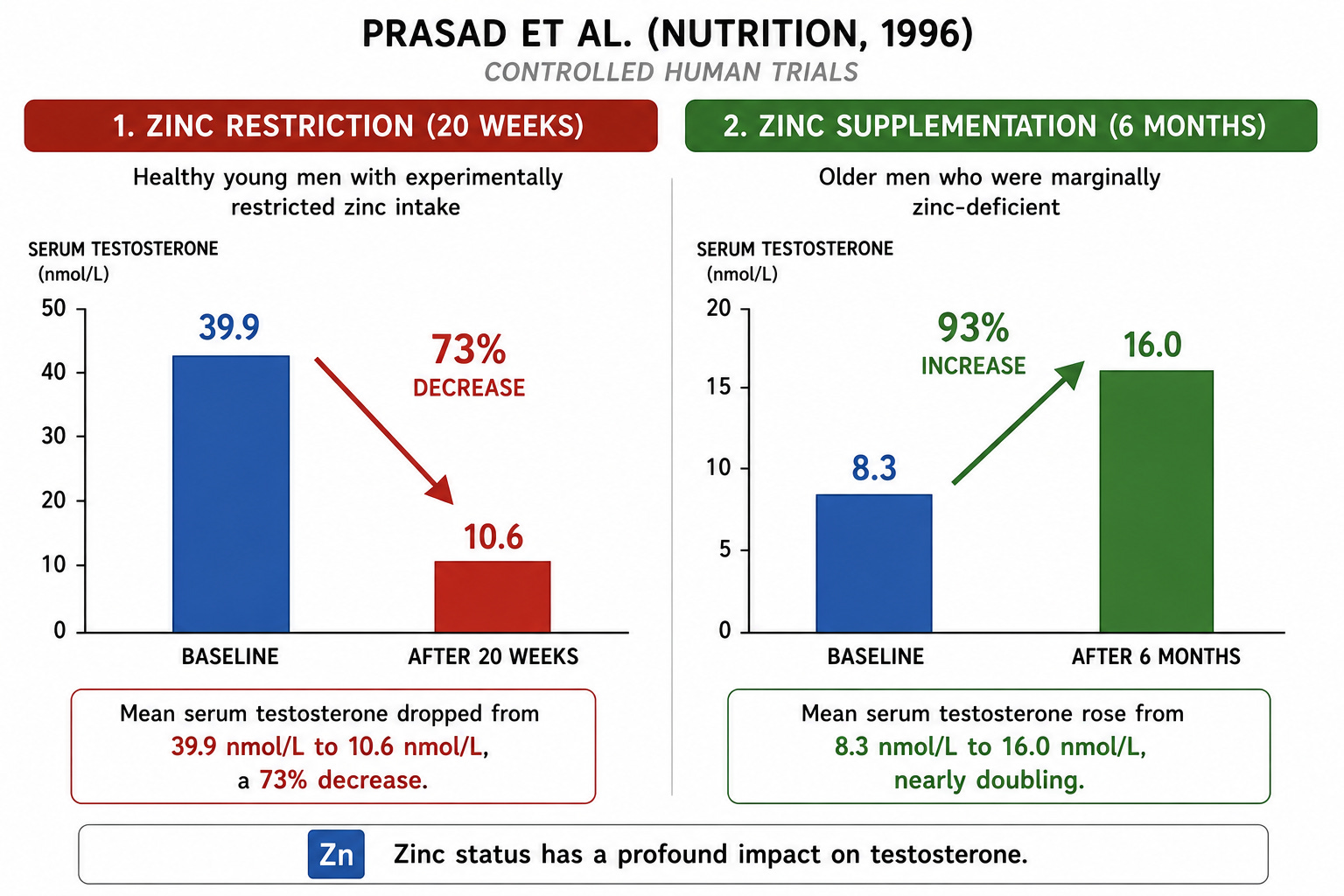
Read that again: a testosterone crash of that magnitude took 20 weeks of restriction, not 20 years. That matters here specifically because someone who switches to a chicken-heavy diet (or even fish) to manage iron, without realizing chicken is also a poor zinc source, could be inadvertently tanking their testosterone within months, on top of failing to actually fix their original problem.
I want to be precise about what is and isn’t proven here. There’s no study tracking someone eating a chicken-forward, zinc-marginal diet for years and drawing a clean line to a specific hormonal crash point. That extrapolation is mine, built on the biology, not a citation.
What is real: the KORA-Age study found high rates of subclinical micronutrient deficiency in older adults (52% low vitamin D, 27% low B12, 11% low iron, 8.7% low folate), associated with chronic disease and worse functional outcomes, and broader reviews show older adults commonly fall short of RDA targets for several minerals through diet alone.
Layer on top of that a cultural pattern: protein in general has been quietly demonized for years thanks to the saturated fat scare that got bundled in with red meat specifically, and a lot of people already default to small portions of protein overall, with chicken and egg whites as the “safe” choices when they do eat it. Someone actively avoiding red meat to fix their iron just adds another layer on top of an already zinc-marginal starting point.
Apps like Cronometer can tell you exactly what’s in your plate today. They have no memory of the months of chicken-forward eating that got you here, or why you started eating that way in the first place. Check my full article on the shortcomings of Cronometer here and what to do about it.
Not sure where your own iron, zinc, or testosterone status actually sits? Ask Hans can help you think through your specific symptoms and bloodwork in real time. Or if you want a full breakdown of your own hormone, mineral, and gut markers mapped against everything in this article, get a Personalized Health Report built specifically around your data.
Everything above this line is the philosophy and the data. What follows is the specific, practical protocol: the methods that actually move ferritin and iron status, ranked by what’s produced the clearest results, in myself and in the research.
You’re the exception, not the rule
I know exactly what pushback this gets, because I get it constantly: “I’ve eaten chicken breast for iron management for years and my testosterone is fine.” Fair, and I’m not going to tell you that you’re wrong or secretly deficient without knowing it. Individual variance in zinc requirement is real.
Absorption efficiency differs meaningfully from person to person. Gut health, detoxification load, genetics, and half a dozen other variables shift how much zinc someone actually needs to stay in range. Someone with excellent absorption and low baseline requirements can genuinely do fine on a diet that would deficiency someone else within a few years.
That’s exactly why this article isn’t a claim that chicken-heavy eating crashes testosterone in everyone. It’s an argument against assuming you’re in the clear just because you feel fine right now, and in favor of testing rather than guessing.
A good illustration of how large this individual effect size can be: I know of a case where a guy on a beef-heavy diet ran testosterone in the 700s ng/dL. He switched his primary protein source to salmon. Six weeks later, his testosterone had dropped to 306. He switched back to beef, and it returned to the 700s.
What it is a strong example of, is just how sensitive some individuals’ androgen production can be to protein source for reasons that may have nothing to do with iron at all, and everything to do with the low absolute zinc density salmon provides regardless of its favorable ratio. Ratio and density are two different variables, and this case likely implicates density more than ratio.
How to actually lower iron
My top 8 methods of how I dropped my ferritin from almost 600 to 180 without blood donations are discussed below. 👇
Still on the fence? We're #1 in male optimization on Substack and Top 10 in Health & Wellness globally, built on one rule: never insult your intelligence. Data-first, nuance-always, no fluff. Ever. The 1,000+ premium readers inside know exactly what that's worth.